Can I Go Back to Golgotha Prison Wild Arms
The name is not subtle, but the reference itself is actually oddly superficial. At the end of the dungeon, Ashley is separated briefly from the party and Lilka and Brad are captured and tied to crosses, evoking the characters Dismus and Gestas, the thieves crucified during the same execution as the biblical christ. There is little reference to that actual narrative however, instead seeming to draw from the fact that the name Golgotha is taken to be an epithet to mean literally "A Place of Skulls," which seems rather appropriate and obvious for an execution field.
Bookending the start and end of this dungeon, we fight the boss monster, Trask. First in a scripted "loss" and then in a solo match with Ashley's new dark henshin hero form, the "Grotesque Black Knight," Knightblazer.

"Trask" is yet another transliteration* issue that comes from the juggling between languages. It actually comes from the Tarrasque, another monster most readily identified from its appearance in the original Dungeons & Dragons Monster Manual, itself originally taken from semi-obscure French myth of Saint Martha of Bethany and the Tarasque of Tarascon.
*(I realize I use this word a lot and it might not be as common use to others. A "translation" lifts meaning between languages; a "transliteration" is to lift written characters between them. Example: "Left" in English translates to 左[the direction] or 残[what remains] but transliterates to レフト. Inversely 左 and 残 both translate back to English as "Left" but transliterate as "hidari" and "zan" respectively; and レフト transliterates back into English as "refuto.")

Surprisingly, the Wild Arms 2 design (which would also go on to persist as the core design throughout the rest of the Wild Arms series) is based more on the original myth than the D&D representations tend to be: While the end product looks nothing like the depictions of the Tarasque of myth, it retains the spiked turtle shell, the prominent dual horns, poisonous quality, and fins on its head here account for being "half fish."
Also of note is that the title card identifies it as a "Dragonoid" and it has various metallic and machine-like features. These details are neat because it positions it as being not-quite a dragon, to work around a fact that will pop up much later: That dragons in Filgaia are extinct. And also to play into the fact that Dragons in Wild Arms are semi-mechanical lifeforms.
In any case, our scripted loss toTraskthe first time around ends with the team knocked out and imprisoned in what appears to be a disused execution ground and associated holding cells. In our escape we run into monsters fitting the theme, who appear to be natural inhabitants, rather than guards put in place by the Odessa terrorist soldiers who are actually holding us here.

First up is the Wight, a classic undead warrior monster generally taken from D&D, but with a little more behind it than you might expect. The term Wight in English lore actually traces back quite far as an archaic term with little to no real association with monsters. The real intersection with name and subject comes from an early English translation of the Nordic Grettis Saga; In it the zombie-like creatures now better known as Draugr were referred to as apturgangr (lit."againwalker") but were translated as Barrow-wight. (lit."[burial-]mound person")

This may seem an odd choice, but the translation came at the hands of the eminent bookman William Morris. I say "bookman" because he was not just a prolific author of prose and poetry, but a pioneer of the revival of the British textile and printing industry. He and his wife, Jane Burden, did extensive arts, craft and design work in book and print design, book binding, and wall paper all stemming from the intricate design of modular and tiled printing blocks and stamps. Oh and he translated various works of epic poetry and myth into English, including old Roman epics, French knightly romances, and of course Norse sagas. (all of which he wrote and published what was basically fanfiction of, btw)
His seemingly erroneous "translation" of the Barrow-wight came as an attempt to reflect a comparable agedness to the name: Rather than translating from old Norse into modern English, he chose what he thought a suitable old English equivalent; "Barrow" referring to pre-christian Anglo-Saxon burial mounds, and "Wight" meaning "thing" or "creature" but often used disparagingly to refer to a person. The nuance there is actually quite clever, as the old Wight referred pretty exclusively to those living, even if it didn't specify by definition, and that uncertainty or contradictory kind of implication uniquely fits a description of the undead.
This term would be picked up by J.R.R. Tolkein for use in Middle-Earth, retaining their lore and function from Norse legend to describe undead warriors. And from there you can follow the usual chain of influence to D&D, where the shortened term Wight really solidified itself as synonymous with the undead, and eventually down to Game of Thrones, where George R.R. Martin cleverly brings the whole thing back around to old risen bodies of northern warriors, not unlike the Draugr of Norse myth.
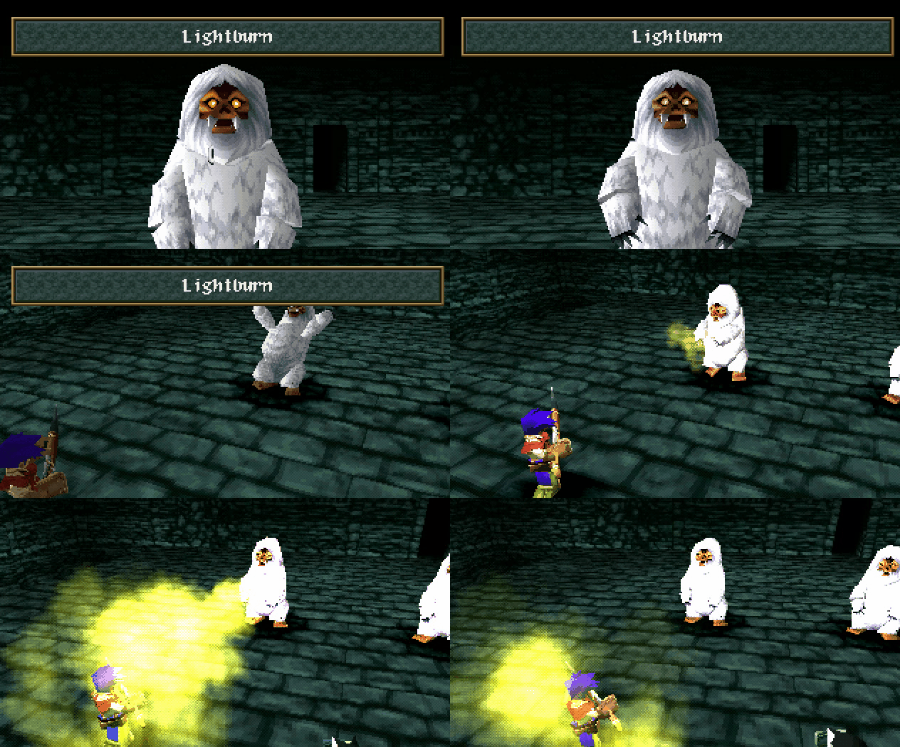
Anyway in Wild Arms 2 we get some sorta death yeti ¯\_(ツ)_/¯

Next up is the Ghoul, which I think we all know is a pretty generic term in modern parlance, but it's specific origins date back to pre-Islamic Arabia. It entered into English via translations of the original French translation of 1001 Arabian Nights, where it appears in one story as a monster lurking about the cemetery devouring corpses.
The Ghoul identity as a corpse eater quickly broadened into flesh eaters, and the association with lurking about graves in turn marked them as undead themselves until eventually the term became loosely applied to any variety of undead, including the thrall of vampires, supplanting the flesh of the dead with blood of the living and achieving a truly far removed meaning. Even in modern Arabic the term now broadly applies to any number of fantasy monsters.

And so long as we're dabbling in pop culture transplants; the Arabaian word Ghul is in fact the same used in the name of the Batman villain, R'as al-Ghul, whose name/title has always been erroneously translated as "Head of The Demon."

I have no idea why it's a chicken with a mohawk but i love it

And finally the Bone Drake. I don't know that this one actually has any real specific lineage…
"Drake" is generally a synonym for dragon, although there is some case of fantasy semantics where different settings will try to define distinct body types of dragons each with their own name, in which case Drakes are often either dragons which simply don't exceed a certain size (generally no bigger than a non-magical animal such as a dog or a horse) or a wingless variation of whatever the setting's prototypical dragon might be. I don't know for certain, but I think this distinction in modern fantasy started with Tolkien's wingless fire breathing dragon, Glaurung, and its offspring who were referred to as fire-drakes.

In any case, the specific term "Bone Drake" Doesn't seem to appear with any visibility prior to Wild Arms 2, which leads me to believe it was just their name for a generic bone dragon-like creature. It does make for an interesting companion, aesthetically, to Trask being here, although there don't seem to be any implications that Trask lives in this dungeon at all. Other than just being an obvious combination of cool fantasy things, it may also be pulled from Dungeon & Dragons' Dracolich/Night Dragon; an undead (often skeletal) dragon raised from the dead, often by their own necromantic spells, hence the term "Lich." For whatever reason they are oddly reminiscent of shield crested dinosaurs like the Triceratops or Styracosaurus.
The attack Rhodon Breath doesn't tell me anything either. I think it's just meant as "Rose Breath," translating the "Rhodon" bit pretty literally, and references the smell of roses being present as a funeral, or else the palor of the faded pink color also called "Rose Breath." There is some apocryphal reference to a Rhodon but of no significance that I can tell.
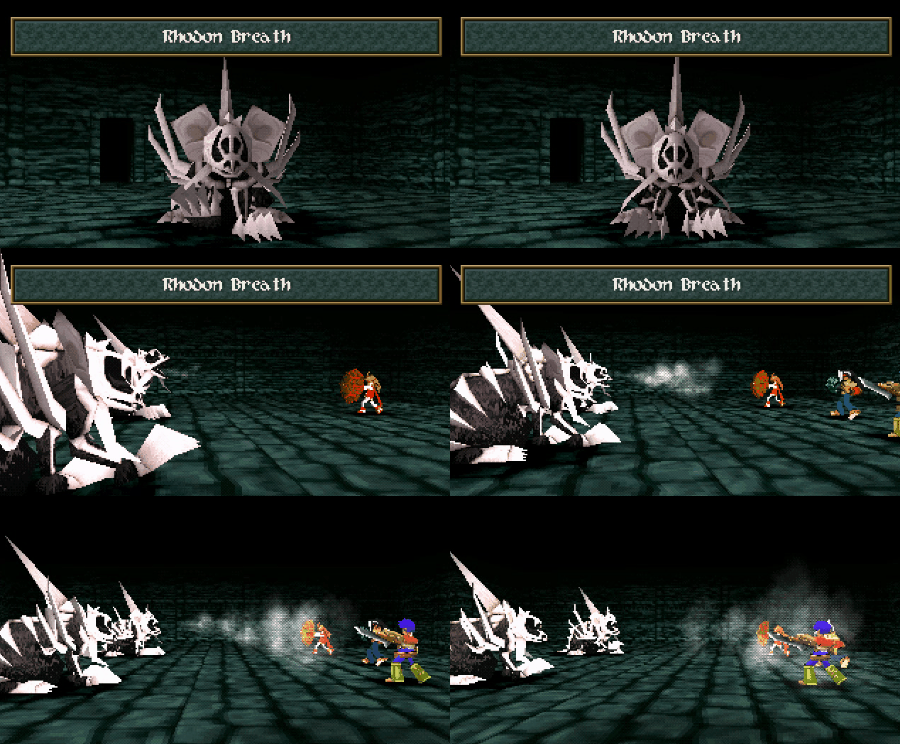
Clearly the theme here is death and the undead, and with some small stretch on part of the Wight, we could even say skulls all befitting Golgotha's "Place of Skulls" epithet. It's a really neat way to build this dungeon, albeit a little on the nose. But I really like the idea that the dungeon appears to be abandoned and now haunted by all these reanimated corpses and bones before the villains arrive to use it for their plans. Oddly there isn't much of a martyrdom theme here, although we'll get plenty of that a little later once we recruit our second magic user, summoner, christ figure, and perfect beautiful boy, Tim Rhymless to the team…

Anyway we get out, we fight Trask for real. Ashley turns into a saturday morning superhero. Trask gets solo'd. And we all just kinda move along without asking too many questions… Although the game dialogue describes this new form as a "grotesque black knight" the sprite work, 3D model, and even original character art don't really convey much in the way of "grotesque" but in the context of the tokusatsu, henshin hero elements it's not too hard to imagine that the design was meant to evoke a similar aesthetic to gruesome suit heroes like Guyver, Kamen Rider Shin, and Devilman. I do love the gill/tendon-like organic vent structure in the pauldrons that stay. And although it's not visible in any of these images, but the D-Arts model has an exposed segment of vertebrae between the shoulders; that along with the teeth(?)/ribs on the open chest panels really helps bring out more of the "grotesque" quality of the design.
I totally forgot I had these books in my apt with me. I wish I had access to a decent scanner to really do these justice but for now here's some more KnightBlazer art that helps sell that "grotesque black knight" look
Can I Go Back to Golgotha Prison Wild Arms
Source: https://dungeonecologist.tumblr.com/post/184259179895/wild-arms-2-golgotha-prison
0 Response to "Can I Go Back to Golgotha Prison Wild Arms"
Enregistrer un commentaire